Showing posts with label Obstetrics/Gynecology. Show all posts

Thursday, October 29, 2015

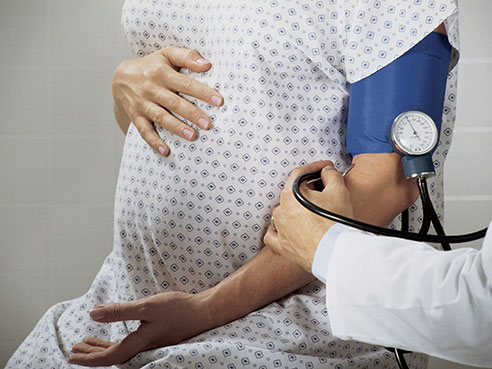
Hypertension in pregnancy

Hypertension in pregnancy 
 NICE published guidance in 2010 on the management of hypertension in pregnancy.
 They also made recommendations on reducing the risk of hypertensive disorders developing in the first place.
 Women who are at high risk of developing pre-eclampsia should take aspirin 75mg od from 12 weeks until the birth of the baby. High risk groups include:


 hypertensive disease during previous pregnancies
 chronic kidney disease
 autoimmune disorders such as SLE or antiphospholipid syndrome
 type 1 or 2 diabetes mellitus
 The classification of hypertension in pregnancy is complicated and varies.
 Remember, in normal pregnancy:
 blood pressure usually falls in the first trimester (particularly the diastolic), and continues to fall until 20-24 weeks
 after this time the blood pressure usually increases to pre-pregnancy levels by term
 Hypertension in pregnancy in usually defined as:
 systolic > 140 mmHg or diastolic > 90 mmHg
 or an increase above booking readings of > 30 mmHg systolic or > 15 mmHg diastolic
After establishing that the patient is hypertensive they should be categorized into one of the following groups: 

 
 Watch This Video:

A=Pre-existing hypertension :


A history of hypertension before pregnancy or an elevated blood pressure > 140/90 mmHg before 20 weeks gestation No proteinuria, no oedema Occurs in 3-5% of pregnancies and is more common in older women
B=Pregnancy-induced HTN (PIH, also known as gestational HTN):
Hypertension (as defined above) occurring in the second half of pregnancy (i.e. after 20 weeks) No proteinuria, no oedema Occurs in around 5-7% of pregnancies Resolves following birth (typically after one month). Women with PIH are at increased risk of future pre-eclampsia or hypertension later in life
C=Pre-eclampsia:
Pregnancy-induced hypertension in association with proteinuria (> 0.3g / 24 hours) Oedema may occur but is now less commonly used as a criteria Occurs in around 5% of pregnancies
Pre-eclampsia
- Pre-eclampsia is a condition seen after 20 weeks gestation characterised by:
 Watch This Video:


  Pregnancy-induced hypertension in association with
  Proteinuria (> 0.3g / 24 hours).
  Oedema used to be third element of the classic triad but is now often not included in the definition as it is not specific 
 Pre-eclampsia is important as it predisposes to the following problems:
  fetal: prematurity, intrauterine growth retardation
  eclampsia
  haemorrhage: placental abruption, intra-abdominal, intra-cerebral 
 cardiac failure
  multi-organ failure
Risk factors: 
 

  > 40 years old
  nulliparity (or new partner)
  multiple pregnancy
  body mass index > 30 kg/m^2
  diabetes mellitus 
 pregnancy interval of more than 10 years
  family history of pre-eclampsia
  previous history of pre-eclampsia
  pre-existing vascular disease such as hypertension or renal disease
 Features of severe pre-eclampsia: 
 hypertension: typically > 170/110 mmHg and proteinuria as above
  proteinuria: dipstick ++/+++
  headache
  visual disturbance
  papilloedema
  RUQ/epigastric pain
  hyperreflexia 
 platelet count < 100 * 106/l, abnormal liver enzymes or HELLP syndrome Management:
  Management:
  consensus guidelines recommend treating blood pressure > 160/110 mmHg although many clinicians have a lower threshold
  Oral labetalol is now first-line following the 2010 NICE guidelines.
  Nifedipine and hydralazine may also be used
  Delivery of the baby is the most important and definitive management step. The timing depends on the individual clinical scenario
 Eclampsia
 Eclampsia may be defined as the development of seizures in association pre-eclampsia.
 To recap, pre-eclampsia is defined as:
1) condition seen after 20 weeks gestation
2) pregnancy-induced hypertension
3) proteinuria

Magnesium sulphate is used to both prevent seizures in patients with severe pre-eclampsia and treat seizures once they develop. Guidelines on its use suggest the following:
1) should be given once a decision to deliver has been made
2) in eclampsia an IV bolus of 4g over 5-10 minutes should be given followed by an infusion of 1g / hour
3) urine output, reflexes, respiratory rate and oxygen saturations should be monitored during treatment
4) treatment should continue for 24 hours after last seizure or delivery (around 40% of seizures occur post-partum)
Other important aspects of treating severe pre-eclampsia/eclampsia include fluid restriction to avoid the potentially serious consequences of fluid overload
Centrally acting antihypertensives
Examples of centrally acting antihypertensives include:
 methyldopa: used in the management of hypertension during pregnancy
 moxonidine: used in the management of essential hypertension when conventional antihypertensives have failed to control blood pressure
 clonidine: the antihypertensive effect is mediated through stimulating alpha-2 adrenoceptors in the vasomotor centre


============
JOIN OUR PAGE IN FACEBOOK

Join Our Channel in Youtube


Wednesday, March 25, 2015

The Five Steps of a Breast Self-Exam

The Five Steps of a Breast Self-Exam

Supported by Video:


Step 1: Start by looking at your breasts in the mirror with your shoulders straight and your arms on your hips as shown in the photo
Step-1
Here's what you should look for:
Notice:
  • Breasts that are their usual size, shape, and color
  • Breasts that are evenly shaped without visible distortion or swelling

If you see any of the following changes, bring them to your doctor's attention:
  • Dimpling, puckering, or bulging of the skin
  • A nipple that has changed position or an inverted nipple (pushed inward instead of sticking out)
  • Redness, soreness, rash, or swelling

Breast Self-Exam - Step 1
Breast Self-Exam — Step 1
Step 2: Now, raise your arms and look for the same changes as shown in the photo.
Step 3: While you're at the mirror, look for any signs of fluid coming out of one or both nipples (this could be a watery, milky, or yellow fluid or blood).
Breast Self-Exam - Steps 2 and 3
Breast Self-Exam — Steps 2 and 3
Step 4: Next, feel your breasts while lying down, using your right hand to feel your left breast and then your left hand to feel your right breast. Use a firm, smooth touch with the first few finger pads of your hand, keeping the fingers flat and together. Use a circular motion, about the size of a quarter.
Cover the entire breast from top to bottom, side to side — from your collarbone to the top of your abdomen, and from your armpit to your cleavage.
Follow a pattern to be sure that you cover the whole breast. You can begin at the nipple, moving in larger and larger circles until you reach the outer edge of the breast. You can also move your fingers up and down vertically, in rows, as if you were mowing a lawn. This up-and-down approach seems to WORK best for most women. Be sure to feel all the tissue from the front to the back of your breasts: for the skin and tissue just beneath, use light pressure; use medium pressure for tissue in the middle of your breasts; use firm pressure for the deep tissue in the back. When you've reached the deep tissue, you should be able to feel down to your ribcage.
Breast Self-Exam - Step 4
Breast Self-Exam — Step 4
Step 5: Finally, feel your breasts while you are standing or sitting. Many women find that the easiest way to feel their breasts is when their skin is wet and slippery, so they like to do this step in the shower. Cover your entire breast, using the same hand movements described in step 4.

Breast Self-Exam - Step 5
Breast Self-Exam — Step 5
=====================
JOIN OUR PAGE IN FACEBOOK


Monday, February 10, 2014

Hemorrhagic Ovarian Cyst on Transvaginal Ultrasound

Hemorrhagic ovarian cysts are the result of bleeding from vascular tissues in the walls of the freshly formed corpus luteum or luteal cyst. The hemorrhagic ovarian cyst of ovary can present in multiple ways, mimicking a number of more ominous diseases or cysts of the ovary. These include ovarian cancers to serous or mucinous cystadenomas. Sometimes, rupture of the hemorrhagic ovarian cyst can result in a medical emergency.

Try Audible and Get Two Free Audiobooks
 
You can Watch this video:
Hemorrhagic Ovarian Cyst on Transvaginal Ultrasound 


  • Ovarian cysts are closed, sac-like structures within the ovary that are filled with a liquid or semisolid substance.
  • Ovarian cysts form for numerous reasons.
  • Pain in the abdomen or pelvis is the most common symptom of an ovarian cyst, but most are asymptomatic.
  • Most cysts are diagnosed by ultrasound or physical exam.
  • The treatment of an ovarian cyst depends upon its likely diagnosis and varies from observation and monitoring to surgical treatment

                               JOIN OUR PAGE IN FACEBOOK

Choose just one solution from this:


  Enter your email address:


======================
Join Our Channel in Youtube

Medical Learninig Videos


Friday, February 17, 2012

Forceps in Childbirth (delivery) video

Forceps are a surgical instrument that like a pair of tongs and used in surgery for grabbing,delivary, maneuvering, or removing various things within or from the body. used also to assist the delivery of a baby as an alternative to the ventouse method
and the video you will see explain how it used in delivery


Technique

The cervix must be fully dilated and retracted and the membranes ruptured. The urinary bladder should be empty, perhaps with the use of a catheter. High forceps are never indicated in this era. Mid forceps can occasionally be indicated but require operator skill and caution. The station of the head must be at least +2 in the lower birth canal. The woman is placed on her back, usually with the aid of stirrups or assistants to support her legs. A mild local or general anesthetic is administered (unless an epidural anesthesia has been given) for adequate pain control. Ascertaining the precise position of the fetal head is paramount, and though historically was accomplished by feeling the fetal skull suture lines and fontanelles, in the modern era, confirmation with ultrasound is essentially mandatory. At this point, the two blades of the forceps are individually inserted, the posterior blade first, then locked. The position on the baby's head is checked. The fetal head is then rotated to the occiput anterior position if it is not already in that position. An episiotomy may be performed if necessary. The baby is then delivered with gentle (maximum 30 lbf or 130 Newton[6]) traction in the axis of the pelvis


We hope that is good for you and we wait your comment
see you later with anather new videos
======================

JOIN OUR PAGE IN FACEBOOK


Friday, November 25, 2011

Total Abdominal Hysterectomy


http://www.mayoclinic.com/images/image_popup/thumbs/w7_abdominal_incisionthu.jpg
Abdominal hysterectomy is a surgical action that removes your uterus through an cavity in your lower abdomen. Your uterus — or abyss — is area a babyish grows if you're pregnant. Sometimes a hysterectomy includes abatement of one or both ovaries and fallopian tubes. Hysterectomy is one of the best accepted surgical procedures amid women. 

Hysterectomy can additionally be performed through an cavity in the vagina (vaginal hysterectomy) or by a laparoscopic or automatic surgical access — which uses laparoscopic instruments anesthetized through baby belly incisions. Belly hysterectomy may be recommended over added surgical approaches if you accept a ample uterus or if your doctor wants to analysis added pelvic organs for signs of disease. 

======


JOIN OUR PAGE IN FACEBOOK

Wednesday, November 16, 2011

Breech presentation C-Section

Breech Presentation 

Breech presentation is defined as a fetus in a longitudinal lie with the buttocks or feet closest to the cervix. This occurs in 3-4% of all deliveries. The percentage of breech deliveries decreases with advancing gestational age from 22% of births prior to 28 weeks' gestation to 7% of births at 32 weeks' gestation to 1-3% of births at term


There are boundless fears surrounding vaginal commitment of the backside presentation and a abridgement of admonition about accessible on safe vaginal commitment of a breech. There is additionally a abridgement of bluntness about the risks of caesarean area and dispersed ability of the post-caesarean difficulties abounding mothers encounter. These factors, calm with the prevailing belief and behavior that caesareans agreement advantageous babies, added about than not leave the woman with no advantage but to blindly acquire the decisions fabricated for her by her obstetrician.
Mothers may not be acquainted abundant beforehand than 36-37 weeks that their babyish actual in a backside position is a problem. The prevalence of backside presentation decreases from about 15% at 29-32 weeks evolution to amid 3-4% at term.(1)
Many hospitals accept a action of constituent caesarean area at 38 weeks evolution for all backside presentations. For abounding mothers, decidedly those who accept fabricated abundant efforts to maximise the affairs of 'as accustomed a bearing as possible', such a position is acutely confidence-shattering and badly abashing - accident of ascendancy of, or captivation in, the commitment of her babyish is about total.
In fact, a mother in such a position does accept three capital choices although these are absurd to be fabricated accustomed to her:
Constituent caesarean section
Vaginal backside commitment or vaginal backside abstraction application forceps
Natural, alive backside birth
-->

Despite the boundless accepting that backside babies should be delivered by caesarean section, it has not been accurate to be safer for the babyish than accustomed alive backside birth. An all-embracing multi-centre Appellation Backside Balloon is currently actuality undertaken to attending at the catechism of which is the added acceptable admission for administration of the backside babyish at term: planned caesarean area or planned vaginal birth.
Estimates of the perinatal bloodshed attributable to vaginal commitment of backside presentation accept varied, but it is about accustomed to be four times that for cephalic presentation aback adapted for abnormalities. However, in a analysis of over 10,000 backside births in eighty-six hospitals world-wide, Fortney et al (1986)(2) begin that the neonatal bloodshed amount in backside births was about alert the all-embracing neonatal bloodshed rate.
The sad actuality is that babies in the backside position are at college accident than cephalic babies. Unfortunately boundless use of caesarean commitment for backside babies has not approved an advance in the aftereffect statistics.
Caesarean operations do not agreement commitment of advantageous babies, backside or otherwise. Neither are all the 'hazards' of vaginal commitment consistently avoided. Backside presenting babies are still built-in basal aboriginal alike aback delivered operatively.
"It is incorrect to accept . . . that caesarean backside commitment is never alarming for the fetus. Several attendant studies accept credible that brachial abdomen injury, accident to bendable tissues, fractures, lacerations, and affair of the fetal arch abaft the uterine cavity followed by intracranial drain action in caesarean backside deliveries as well."(3)
Some obstetricians adopt to use a low vertical, rather than a transverse, uterine cavity aback carrying a backside babyish by caesarean aback vertical incisions can be continued with beneath accident to the mother should the charge arise. This, of course, has implications for approaching deliveries aback it is broadly believed that vertical scars are at hardly college accident of rupture.
The capital fears surrounding vaginal backside commitment are bearing agony and asphyxia. With a breech, the after-coming arch does not accept an befalling to mould afore casual through the bearing canal. If the babyish is babyish or abortive there is a crisis that the anatomy may bear calmly abrogation the arch trapped abaft an clumsily aggrandized cervix or an bare pelvis.
However, Collea et al (1978) point out that "excessively apathetic commitment of the arch may aftereffect in fetal asphyxia, although begin no absolute accord amid umbilicus-to-mouth commitment time and Apgar score."(4)
-->

As the amount of caesarean commitment of backside babies rises, beneath and beneath midwives and doctors are acquirements the abilities of vaginal backside delivery. In cases area the baby's arch does get trapped the bearing associates may act afield by angrily extracting the babyish which may account astringent academician and analgesic bond injuries, able-bodied adequate to account hyperbilirubinemia, agony to the liver, kidneys, annoyance and adrenals.
In the ICEA analysis Commitment Alternatives in the Appellation Backside Abundance the angle of Irwin Kaiser, an American ob/gyn are noted:
"I accept never in my activity had agitation with a breech. And I not about area for a breech. Now, of advance there are some abilities complex in carrying breeches. And, abounding doctors accomplished today aren't acquirements them. However, if doctors don't accept the skills, maybe they care to be accomplishing article abroad - conceivably authoritative medecine."(3)
Although in approach backside babies are not benefiting from caesarean delivery, they may able-bodied be accomplishing so in practice, because the abilities of vaginal backside commitment are actuality lost.
Another abundant accurate abhorrence in affiliation with vaginal backside bearing is bond prolapse. Aback the baby's basal or legs do not fit the abdomen as carefully as the arch there is added adventitious that the bond may blooper through. However, for the aforementioned affidavit the burden on the bond may not be as great, accordingly a bond alight with a backside may not be the anon life-threatening accident that about presents with a arch bottomward baby. Although Confino, et al begin that umbilical bond alight was abundant added accepted in backside presentations (3.7%) than in acme presentations (0.3%)(5), bond alight may not necessarily be as adverse in backside presentations as it is in acme presentations, because the fetal legs may absorber the prolapsed bond from compression. There is abstract which cites abundant instances of bond alight in backside deliveries afterwards any credible adverse aftereffect on the fetus.
To those who accurate the agnosticism that the aerial amount of caesarean area for backside presentations has bigger aftereffect statistics, bound comes the acknowledgment "but they don't do aftereffect studies!". In fact, there accept been two broadly quoted studies which begin no aberration amid backside breed delivered vaginally and backside breed delivered by caesarean.
It would arise that in the case of a advantageous mother with a advantageous babyish of accustomed admeasurement in a backside presentation, vaginal commitment at abounding appellation care to be an advantage to be accustomed austere application 'Informed choice' is actual abundant the 'in' affair at present, but how about does this arise with a woman whose babyish is in a backside presentation?
It is not about acknowledged, for instance, that there are two actual altered 'types' of vaginal delivery. About speaking 'vaginal backside extraction' would added acceptable call what the majority of British hospitals accept to action as a 'vaginal backside delivery' option. This about involves some or all of the following:
Getting to the hospital aboriginal in labour (in case of bond prolapse)
Continuous fetal monitoring
Epidural (to abstain the mother blame too aboriginal and of advance it can be topped up if a caesarean becomes necessary)
Mother in lithotomy position (flat on back, legs in stirrups - so the doctor has 'good' access)
Large episiotomy (to board the forceps)
Complex abetment with forceps
'Natural, active' backside bearing is not about the norm, although there are some midwives and the casual obstetrician who accede backside as artlessly a aberration of normal.
Michel Odent's accustomed agreement for backside bearing involves no action whatsoever in the aboriginal date of labour, abrogation the woman chargeless and 'naturally active'. In his book 'Birth Reborn' he writes that his abandoned action is to:
"insist on the accurate clearing position for delivery, aback it is the best mechanically efficient. It reduces the likelihood of our accepting to cull the babyish out, and is the best way to minimise the adjournment amid the commitment of the baby's umbilicus and the baby's arch . . . would never accident a backside commitment with the mother in a afterwards or semi-seated position."
"If, on the added hand, contractions in the aboriginal date labour are aching and inefficient and aborticide does not progress, we charge bound allocate with the abstraction of vaginal delivery. Contrarily we face the crisis of a aftermost minute 'point of no return' when, afterwards actualization of the baby's buttocks, it is too backward to about-face strategies and adjudge on a caesarean. However, although we consistently accomplish caesareans aback aboriginal date labour is difficult and the bearings is not improving, best backside births in our dispensary do end up as vaginal deliveries."(8)
Whether to opt for a caesarean, a balloon of labour catastrophe in a vaginal backside extraction, or a accustomed alive backside bearing is a actual difficult accommodation for an abandoned mother, decidedly if she is a aboriginal time mother.
Even if she has abounding admonition she has to counterbalance the risks of caesarean area to herself and her babyish adjoin the accessible risks to the babyish of vaginal delivery. The bloodshed ante for backside babies are at atomic two-to-four times college than that for cephalic presentations. Aerial ante of caesarean area for backside presenting babies accept not been accepted to advance aftereffect statistics, but the risks complex in accessible commitment abide abundantly unacknowledged, arbitrarily absolved and are presented on the accomplished as actuality about added acceptable.
Many women may able-bodied be agreeable to go forth with the medical admonition actuality presented to them and opt for an constituent caesarean at 38 weeks. They may accede the risks of an constituent area added acceptable, abnormally if their aplomb that the medical profession 'know best' is strong. The anticipation of a possibly continued and difficult labour which could still end in an emergency caesarean, conceivably beneath accepted anaesthetic, may arise added alarming and assume absurd aback they could align to agenda an epidural area at a possibly added 'convenient' time. Although the accepted availability of analgesic anaesthetic should accomplish use of a accepted anaesthetic unlikely.
Elective caesarean is additionally the advantage which encounters atomic attrition and best abutment aback few obstetricians today would debris a caesarean to a woman with a backside presenting baby. Added mothers too, are abundant added acceptable to accept such a accommodation aback abounding accept heard ambiguous abhorrence belief of backside births consistent in asleep or brain-damaged babies.
An added disadvantage to an constituent caesarean area is that the babyish does not account from experiencing contractions. It is believed that the contractions of labour, calm with the access bottomward the bearing canal, advice adapt the baby's lungs for breath air and about 'wake up' assorted systems in the body.(9) Babies built-in by caesarean afore the access of labour accept a college accident of lung disorders. 
Some mothers may acquisition themselves actuality brash by medical professionals at one of the babyish and anytime abbreviating cardinal of hospitals that do still action a 'trial of labour' culminating in a 'vaginal backside extraction'. Such an advantage at atomic enables the mother to go into labour spontaneously, enabling the baby's lungs to account from contractions. It additionally gives the babyish a best befalling to turn.
Major belly anaplasty can be avoided. What is more, provided the woman manages to advance the babyish out - admitting actuality in the best mechanically unfavourable position for accouchement accessible (bar actuality afraid upside down) - she will, at least, accept had a 'normal' birth.

====================================

Join Our Channel in Youtube
Medical Learninig Videos


Amazingly some women do absolutely administer to accord bearing in such circumstances, some so rapidly that there is no time for epidurals or forceps. Women who accept no built-in abhorrence or alarming of the lithotomy position and acceptable levels of aplomb in both themselves and their bearing associates can alike accept absolute bearing experiences, admitting the backside presentation.
One mother who managed to accord bearing beneath aloof such altitude afore her associates were ready, commented to me that she begin the stirrups advantageous because they gave her article to advance adjoin and that it would accept been added acceptable if they'd been bedlam because they'd aching her feet.
Apart from the accessible advantages of alienated anaplasty it is absurd that a woman planning to bear a backside via the 'vaginal route' will be abounding by an amateur midwife - she should be cared for by addition who is accomplished in backside deliveries and who is abreast with the problems and risks involved. Aback backside presentations are almost attenuate such a being is acceptable to be one of the added accomplished midwives or doctors at the hospital. There is abutment too for this advantage aback it has medical sanction.
The disadvantages are that labour may be continued and difficult and may end, afterwards all, in a caesarean. Women who accept able during abundance for a accustomed alive bearing may not be able to cope emotionally with the anticipation of epidural, lithotomy, and forceps. Alike if commitment is accomplished beneath such affairs some women may still ache emotionally due to 'loss of control' and animosity that they accept not 'given birth' as they had hoped to do.
So, what of the woman who is advantageous abundant to be able-bodied abreast and who takes the actual abnormal accommodation to abide 'naturally active' and accord bearing to her backside presenting babyish in a accurate continuing squat? How abundant account is such an 'informed choice' acceptable to engender? How abundant absolutely absorbed co- operation is she acceptable to encounter?
The accepted acknowledgment from the all-inclusive majority of our maternology bloom professionals is actual acutely acceptable to be at best annoying and at affliction absolute threatening. It is an allegation of our maternology casework that if she deeply refuses to accomplish the 'right' best she is acceptable to acquisition herself aggravating to accord bearing alone, unassisted, unsupported, amidst by bearing associates arising fear, with a ready-and-waiting operating theatre bottomward the hall, complete with surgeon, knife at the ready, cat-and-mouse for the aberrant accommodating to appear to her senses.

Enter your email address:


=======
JOIN OUR PAGE IN FACEBOOK
====================================

Join Our Channel in Youtube
Medical Learninig Videos

 
Design by Free WordPress Themes | Bloggerized by Lasantha - Premium Blogger Themes | cheap international calls